AI in software development started with code suggestions and chatbots. It is now moving towards agentic engineering: AI agents that plan a task, reason through it, use tools, write code, run tests, read the results and improve their own work.
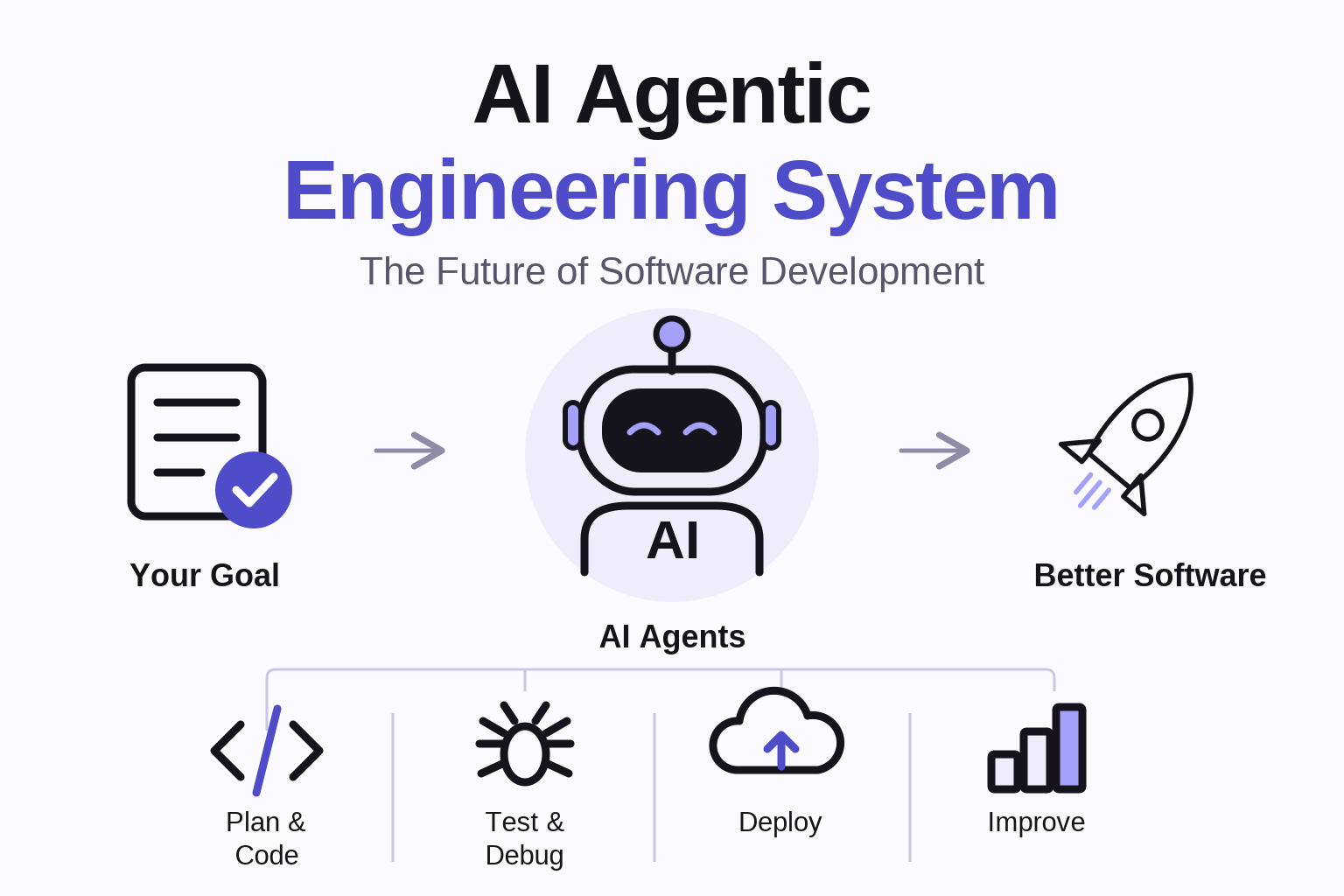
The shift is not only that developers write code faster. It is that people and AI agents work together inside one engineering system, with clear roles, checks and limits.
What an agentic engineering system is
It combines large language models (LLMs), agents, tools, memory, workflows and evaluation to complete complex engineering work. Unlike an assistant that waits for every instruction, an agentic system can:
- understand a high-level goal and break it into smaller tasks,
- plan how to carry the tasks out and write or change source code,
- use APIs, databases and other tools,
- run automated tests, find failures and propose fixes,
- check the result against the requirements it was given.
How it is put together
Connecting a model to a prompt is not enough. A reliable system needs structure:
- Planning: turns a request such as "build a login system" into parts: registration, authorisation, database models, API endpoints, security checks and tests.
- Orchestration: one coordinator manages specialised agents, for example for product, architecture, development, testing, security and documentation.
- Tools: Git, APIs, databases, a terminal, browser automation, CI/CD pipelines and monitoring give agents real work to do.
- Memory: requirements, architecture decisions and coding conventions are kept, so the agent does not need the same instructions twice.
- Evaluation: output counts only after unit and integration tests, type checks, linting, security review and a check against the business requirements.
What changes across the lifecycle
| Stage | What agents can do |
|---|---|
| Requirements | Analyse specifications and point out what is missing |
| Planning and architecture | Break work into tasks and propose structure and technology |
| Development | Generate and change code |
| Testing and debugging | Write tests, investigate failures and implement fixes |
| Deployment | Help with build checks, configuration and release preparation |
| Maintenance | Watch for issues and suggest improvements |
This does not remove the need for experienced engineers. It moves their value to architecture, technical decisions, quality, security and business results.
A multi-agent workflow in practice
- A person states the goal, for example a SaaS product with login, subscriptions and reporting.
- A product agent turns it into tasks with acceptance criteria.
- An architecture agent proposes the stack, data model and API contracts.
- Development agents build their parts under shared architectural rules.
- A testing agent runs the tests and reports failures.
- Security and review agents inspect the work.
- A deployment agent prepares the build, configuration and release.
A human engineer reviews the critical decisions and approves anything with high impact.
The challenges
- Reliability: agents can misread requirements, produce wrong results or loop.
- Security: tool access and outside input open the door to prompt injection, data leaks and actions nobody authorised.
- Cost: many agents and repeated model calls add up quickly.
- Context: large projects need the right information without losing architectural detail.
- Observability: teams need to see agent decisions, tool calls, errors and history.
- Human oversight: production deployments, payments and changes to sensitive data need approval from a person.
The answer is not more autonomy. It is the right boundaries, checks and feedback loops.
From AI-assisted to governed autonomous engineering
The direction is clear: describe a product idea and have a system analyse the requirements, design the architecture, build the front end and back end, connect APIs and databases, write and run tests, fix issues, produce documentation, prepare deployment and keep improving what runs in production.
That is not about replacing engineers. It is about giving them more capability. The engineers and companies that learn to design, orchestrate, evaluate and secure these systems will have a clear advantage.
At Alphaise we build AI agents with the same principles: clear tools, clear permissions, a person in control and a record of every action. If you want to see where agentic engineering fits in your own systems, book a discovery call.