A pilot can run on enthusiasm. A regulated business cannot. Once AI touches customers, money, health or public services, the company has to show who decided what, on what data, under which controls. An enterprise AI operating model is how the company organises itself to do that repeatedly, not once.
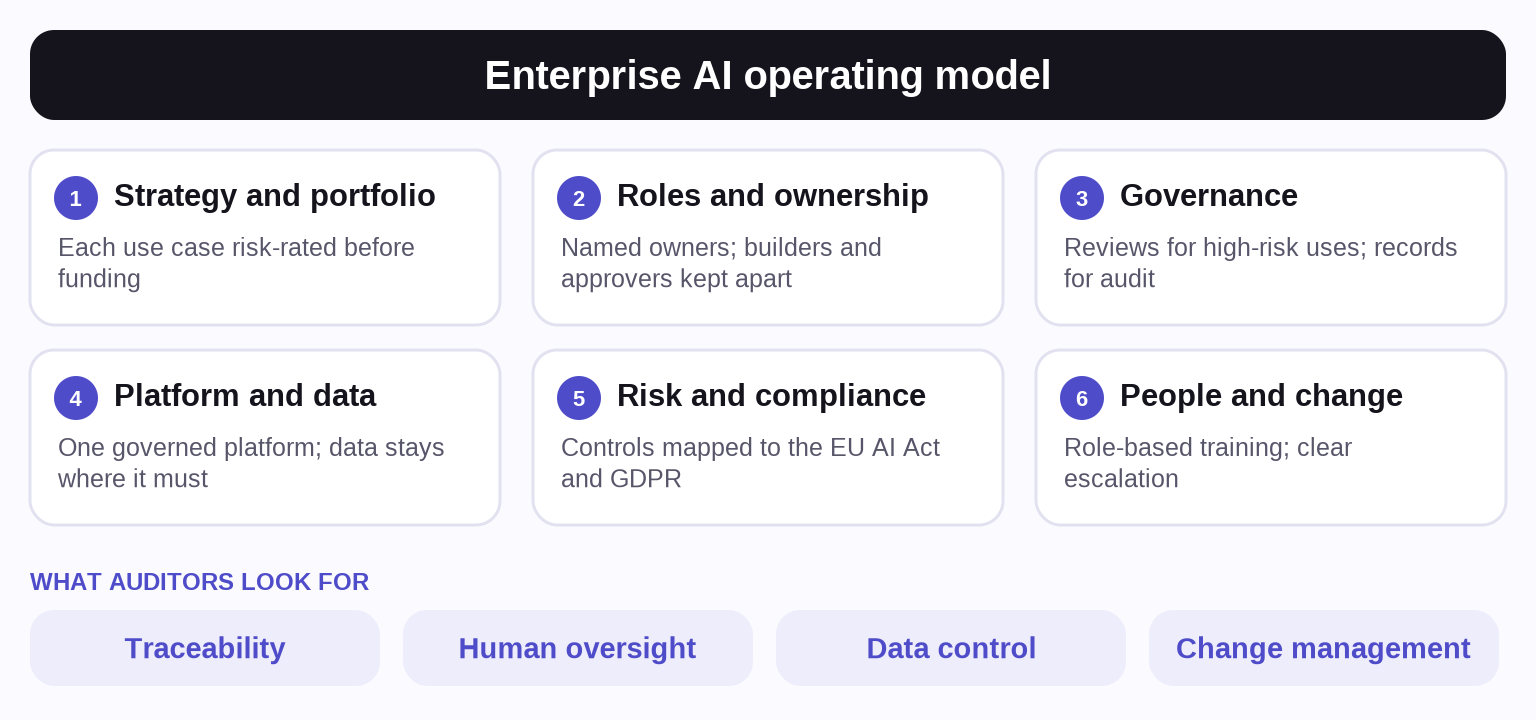
What an AI operating model covers
| Area | The question | In a regulated setting |
|---|---|---|
| Strategy and portfolio | Which use cases, in what order? | Each one risk-rated before it is funded |
| Roles and ownership | Who builds, who owns, who approves? | Named owners; separation between builders and approvers |
| Governance | How are decisions made and recorded? | A review step for high-risk uses; records kept for audit |
| Platform and data | Where does AI run, on what data? | Data residency, access control, one governed platform |
| Risk and compliance | What rules apply? | Controls mapped to the EU AI Act, GDPR and sector rules |
| People and change | How do teams adopt it? | Role-based training and clear escalation paths |
Four things regulators and auditors look for
- Traceability: for any AI-assisted outcome, you can show the input, the model and version, the tools used and the result.
- Human oversight: people review or approve the steps that matter, and you can show that they did.
- Data control: you know where data is processed and who can reach it, and agents see only what the task needs.
- Change management: a new model, prompt or tool goes through the same testing and approval as any other change.
Modernize in steps, not in one project
- Inventory: find every AI system and agent, including shadow AI, and give each an owner.
- Tier by risk: decide which uses need heavy controls and which can move faster.
- Standardise the platform: one place for agents, access control, approvals and logs, instead of one-off integrations.
- Align to a standard: ISO/IEC 42001 gives an auditable management system for AI that fits beside ISO 27001 and others.
- Measure and review: results, incidents and exceptions, reported each quarter.
Do not wait for perfect rules
The EU AI Act applies in stages and guidance keeps evolving. An operating model built on inventory, risk tiers, oversight and records adapts to new rules without a rebuild, because those are what any rule asks for.
If you are deciding how to run AI in a regulated environment, book a discovery call. We will map your current state against these six areas and agree what to do first.
Sources
- EUR-Lex: Regulation (EU) 2024/1689 (AI Act)Requirements by risk level, applying in stages
- ISO/IEC 42001:2023, AI management systemsAn auditable management system for AI, built on the harmonised ISO structure
- NIST AI Risk Management FrameworkA voluntary framework for governing, mapping, measuring and managing AI risk