RAND reported in 2024 that, by some estimates, more than 80 percent of AI projects fail, about twice the rate of IT projects without AI. That figure comes from outside estimates, and RAND's own interviews point to causes that are mostly not technical: the wrong problem, missing data, and no way to tell whether the thing works. The last one is where an evaluation harness comes in.
A demo is not evidence
A proof of concept usually succeeds on hand-picked examples. In production the inputs are messier, the edge cases are real and the model, the prompt or the data changes underneath you. Without a repeatable test, nobody can say whether a change made things better or worse, so teams stop trusting the system and the pilot stalls.
What an evaluation harness is
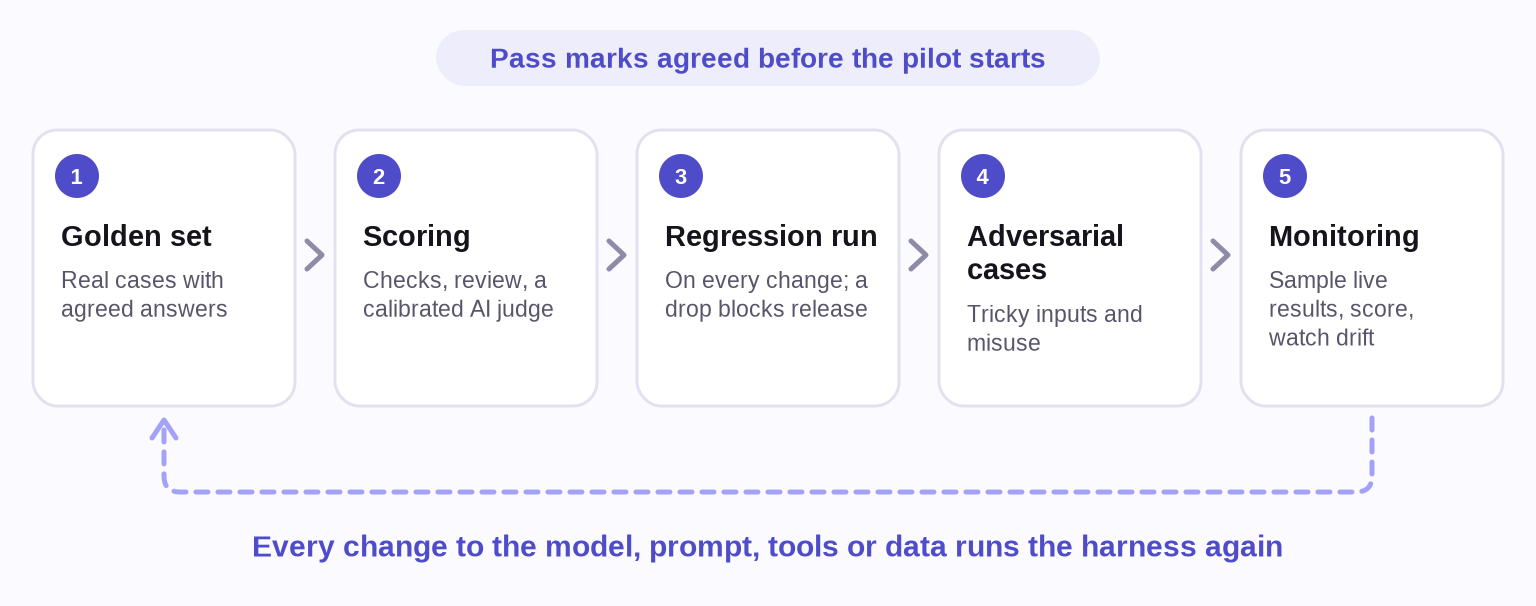
An evaluation harness is a set of test cases, scoring rules and automation that you run against your AI system every time something changes. Think of it as the test suite and the performance review in one.
Five parts that make it work
- A golden set: 50 to 200 real cases from the actual process, with the expected result agreed by the people who do the work.
- Scoring: exact checks where you can (the right invoice total, the right category), human review where you must, and an AI judge only when it has been checked against human scores.
- Regression runs: the full set runs on every change to the model, prompt, tools or data, and a drop blocks the release.
- Adversarial cases: tricky inputs, missing data and attempts to make the system misbehave.
- Production monitoring: sample live results, score them the same way, and watch for drift.
Tie the score to the business
| Layer | Question it answers | Example |
|---|---|---|
| Task quality | Is the answer correct? | Invoice lines extracted correctly |
| Process outcome | Did the workflow finish properly? | Booking prepared without rework |
| Business result | Did it move the number we care about? | Hours saved, errors reduced |
| Safety | Did it stay within its limits? | No action taken without required approval |
Set a pass mark for each layer before the pilot starts, and agree what happens if it is missed. That is what turns a pilot into a decision.
If you have a proof of concept that has stalled, or want to plan one that will not, book a discovery call. We start with the evaluation, not the model.
Sources
- RAND: The Root Causes of Failure for Artificial Intelligence Projects and How They Can SucceedBy some estimates more than 80 percent of AI projects fail, about twice the rate of IT projects without AI; the causes are mostly not technical (August 2024)