The use of AI systems and tools can greatly benefit any business. But it is important not to underestimate the risks they bring if proper security practices are not taken into account.
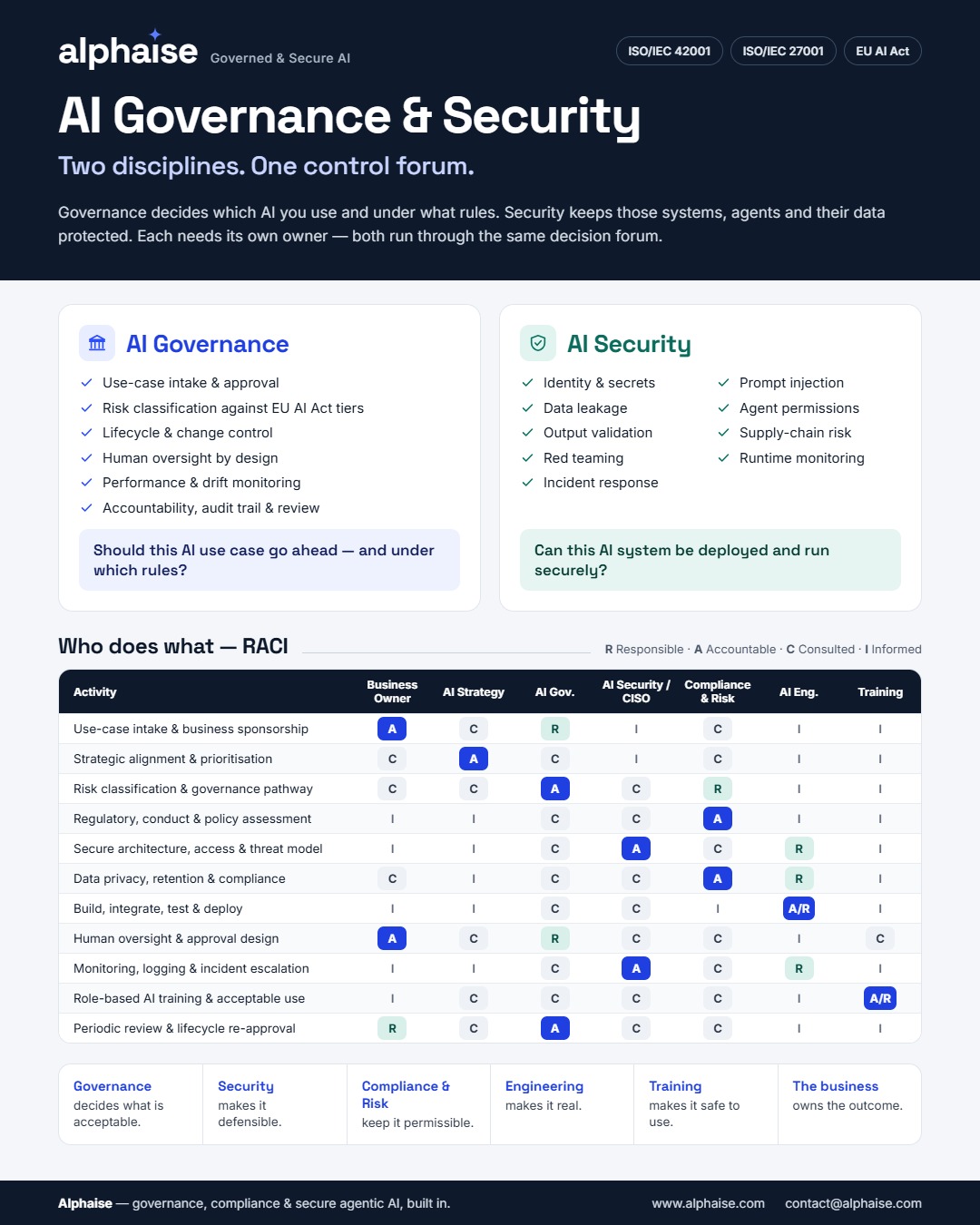
AI security
As businesses, we must ensure that AI systems are protected from attacks such as prompt injection, and that their software is kept up to date. Otherwise, attackers can use vulnerabilities to gain control of a system and expose sensitive information, which can cost clients dearly in both money and reputation.
Incorporating security principles such as the Confidentiality, Integrity and Availability (CIA) triad into the AI systems we build provides a solid foundation for security:
- Confidentiality ensures that data and resources are protected from unauthorized access or disclosure.
- Integrity protects data from being altered or destroyed by unauthorized actors, ensuring accuracy and trustworthiness.
- Availability ensures that authorized users have timely and uninterrupted access to their critical systems and data.
AI governance
We make sure that human users have defined roles, with access to specific resources and a set of allowed actions. The same must be considered for the AI systems we build and manage.
Take a finance AI agent instructed to cut costs. If it decides to delete some expensive cloud services on its own, without oversight and approval from an authorized person, it can cause a lot of trouble for business operations.
To help put proper controls and policies in place, the European Union's AI Act provides a framework for building compliant AI systems. It entered into force in August 2024 and applies in stages.
Sources
- EUR-Lex: Regulation (EU) 2024/1689 (AI Act)The EU AI Act as the legal framework for AI systems, in force since August 2024