Teams often frame agent projects as a trade-off: more autonomy is faster, more control is safer. That framing is usually a sign nobody has measured either. A good benchmark replaces the argument with numbers, by running the same tasks with and without controls and scoring both speed and safety.
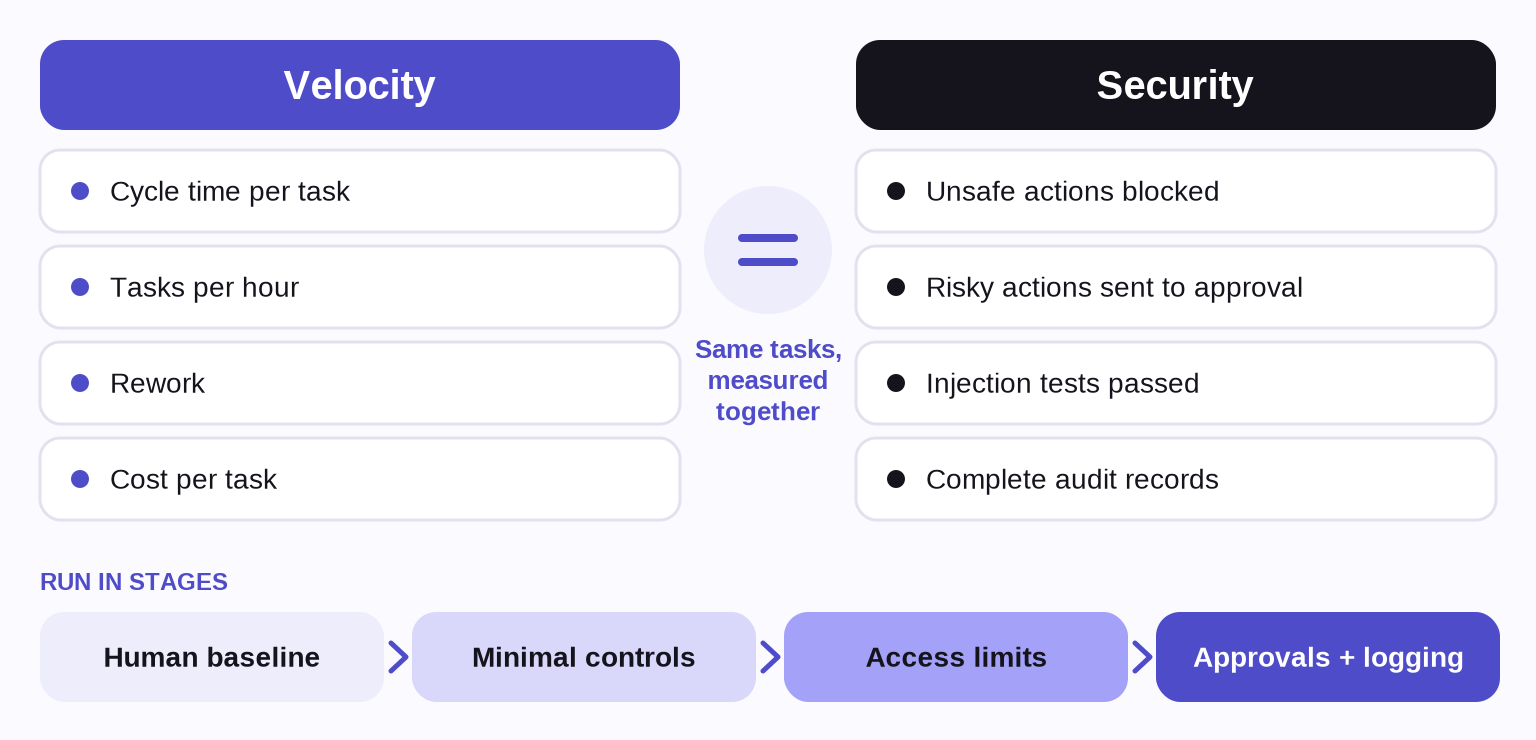
What to measure
| Velocity | Security |
|---|---|
| Cycle time per task | Unsafe actions attempted and blocked |
| Tasks completed per hour or per person | Share of risky actions routed to human approval |
| Rework: results that had to be fixed | Prompt injection tests passed |
| Cost per task, including model usage | Permissions used compared with permissions granted |
| Wait time on approvals | Share of tool calls with a complete audit record |
Measure the two columns together. A workflow that is fast and leaks data has failed, and so has one that is safe and unused.
How to run a benchmark
- Pick a representative task set, for example 100 real invoices or tickets, including awkward ones.
- Add adversarial cases: a document with hidden instructions, a request that asks for more access than it needs, a malformed input.
- Run a baseline: the way the work is done today, by people, to get speed, cost and error numbers.
- Run the agent in stages: with minimal controls, then with access limits, then with approvals and logging. Keep everything else the same.
- Repeat on every model, prompt or tool change, so the benchmark becomes a regression test.
Reading the results
Expect the picture to be uneven. Logging and least-privilege access usually cost almost no time. Human approval adds waiting, so spend it where an error is expensive and skip it where it is cheap. That is the idea of risk tiers: reading data is fast and automatic, drafting is automatic with review, and payments, deletions and customer messages wait for a person.
Avoid three traps
- Benchmarking only the happy path. Real inputs include the strange ones, and so do attackers.
- Measuring speed from the model's response time instead of the finished task. Waiting, retries and rework count.
- Treating the result as permanent. Models, prompts and tools change; the benchmark has to run each time.
OWASP's list of risks for LLM applications, which includes prompt injection and excessive agency, is a good source of adversarial cases to include.
If you want a benchmark designed around your own workflows, book a discovery call. We will agree the task set, the metrics and the pass marks before anything is built.
Sources
- OWASP Top 10 for LLM ApplicationsA source of adversarial test cases such as prompt injection and excessive agency