AI is now a board topic. Directors are asked to approve budgets, accept risk and answer to regulators, often without a clear picture of what AI the company actually uses. The answer is not a technical deep dive. It is an enterprise AI governance framework that gives the board a stable way to ask questions and judge the answers.
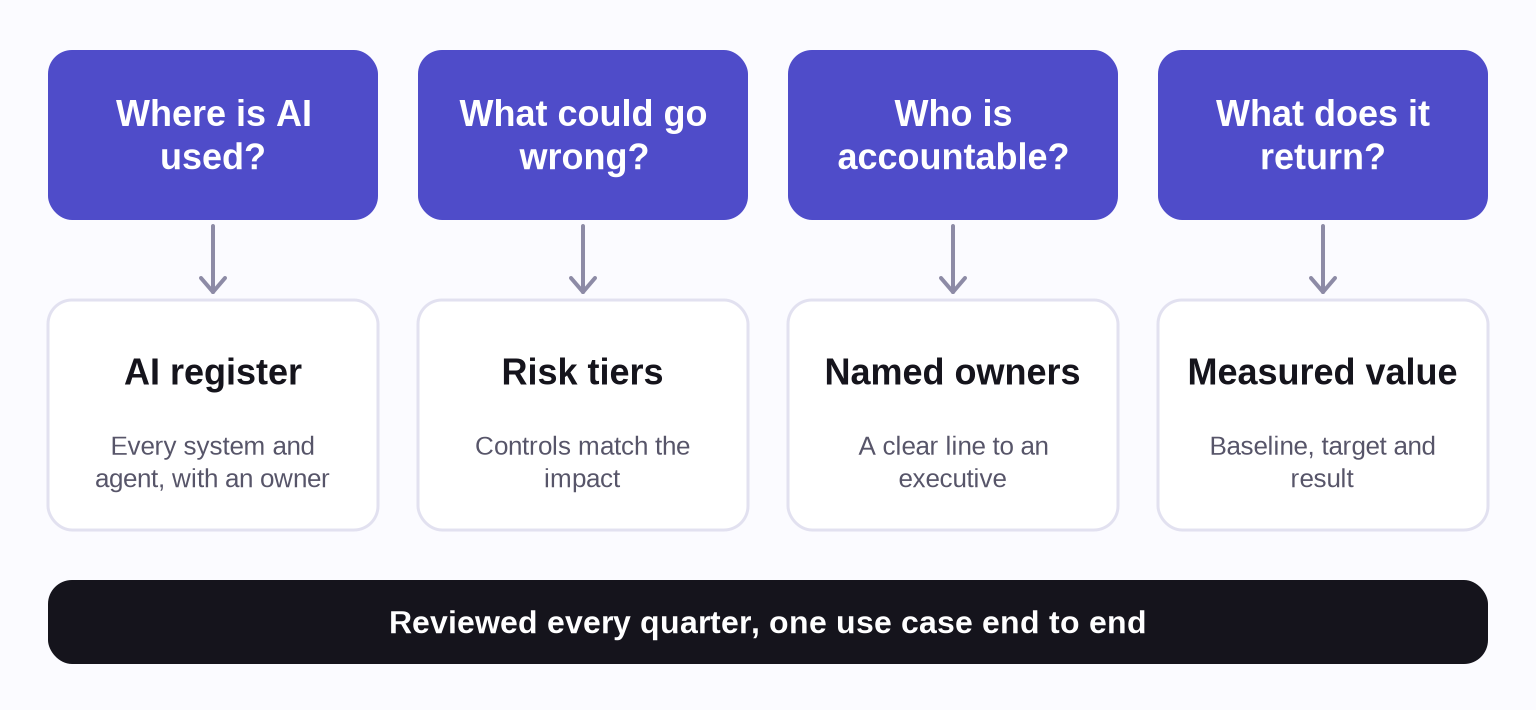
The four questions a board should be able to answer
- Where is AI used? A single list of every AI system and agent, including tools staff adopted on their own.
- What could go wrong? The risks for each use, ranked by impact: wrong decisions, data leaks, bias, regulatory breaches, outages.
- Who is accountable? A named owner for every system and a clear line to an executive.
- What does it return? Measured results against a target agreed before the work started.
If management cannot answer one of these in a few minutes, that is the finding.
A framework that fits on one page
| Part | What it covers | What the board sees |
|---|---|---|
| Inventory | Every AI system, agent and vendor, with owner and purpose | A register that is kept up to date |
| Risk tiers | Low, medium and high impact, with different controls for each | How many systems sit in each tier |
| Controls | Access, human approval, logging and testing before and after release | Exceptions and incidents |
| Roles | Who does the work, who is accountable, who is consulted | A RACI table by activity |
| Value | Baseline, target and measured result per use case | ROI and payback, per quarter |
Standards and regulation give you a head start
You do not need to invent this from scratch. ISO/IEC 42001 describes an AI management system with policies, roles, risk assessment and continual improvement. The EU AI Act sets duties by risk level and applies in stages. The NIST AI Risk Management Framework offers a shared vocabulary for mapping and measuring risk. Mapping your controls to these makes board reporting and audits far easier.
Posture is a habit, not a document
A policy that is approved once and never looked at again is not governance. Put AI on the board calendar: a short quarterly report with the register, the risk tiers, incidents, and results against targets. Ask management to show one use case end to end each time, from the business goal to the audit log.
If you want to see what that reporting looks like on a live platform, book a discovery call and we will walk through it with your own use cases.
Sources
- ISO/IEC 42001:2023, AI management systemsThe international standard for an AI management system, published December 2023
- EUR-Lex: Regulation (EU) 2024/1689 (AI Act)Duties by risk level, applying in stages
- NIST AI Risk Management FrameworkA shared vocabulary for mapping, measuring and managing AI risk