AI coding has moved beyond code completion. Tools such as Claude Code can read a project, follow its conventions, use tools and carry out multi-step work. But the real gain does not come from asking AI to write code. It comes from building a structured system where AI knows how your team builds software.
1. Skills: specialised knowledge, written once
Skills are reusable instructions an agent picks up when they are needed. Instead of explaining your architecture, coding standards or business rules in every session, you define them once. Good candidates:
- front-end standards for React and Next.js,
- API and back-end conventions,
- testing and debugging routines,
- database migration procedures,
- code review guidelines.
2. MCP: a connection to your engineering tools
The Model Context Protocol (MCP) lets AI use external tools and services. An agent can then read and update documentation, query a database, work with GitHub, look up a design system or call an internal API. The assistant stops being isolated and becomes a connected part of the engineering process. Connections need the same care as any other access: give each one only the permissions the task needs.
3. Hooks: guardrails that always run
Hooks run automatic actions at set points in the workflow. For example, format code after a change, run tests before a task counts as done, validate files before a commit, trigger a security check or block changes to protected files. An instruction in a prompt can be ignored; a hook runs every time. That makes the process predictable.
4. Agent orchestration: more than one assistant
Larger tasks can be split between specialised agents. For a new feature, that could be:
- a planner that turns requirements into a technical plan,
- a front-end agent that builds the interface,
- a back-end agent that builds APIs and business logic,
- a testing agent that writes and runs tests,
- a reviewer that looks for problems before a person does.
An orchestration layer coordinates the agents, handles dependencies and combines the results.
5. SDK patterns: your own AI engineering platform
With the Claude Agent SDK, you can build your own agent-powered tools. Typical uses are automated code review, bug investigation, repository analysis, internal engineering assistants and multi-agent development pipelines tailored to how your organisation works.
The bigger picture
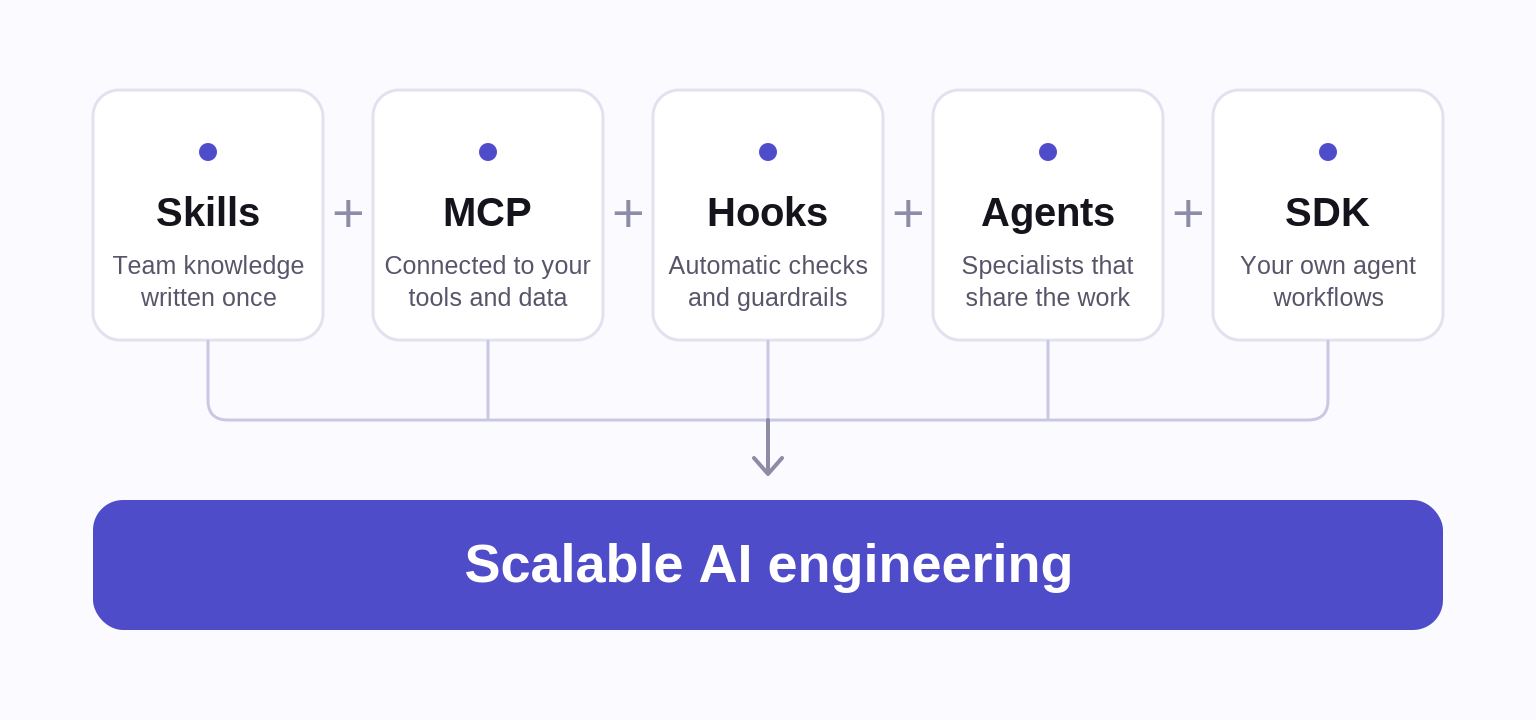
None of these parts is enough alone. Together they form an operating model: skills carry the knowledge, MCP the connections, hooks the guardrails, agents the division of work and the SDK the flexibility to fit your organisation.
This is not about replacing developers. They define the architecture, set the rules, supervise the agents and focus on harder problems. The role shifts from writing every line to designing, supervising and improving the system that builds the software.
That also means the system needs control: clear permissions, logging of what agents do and a person approving high-impact actions. It is the same thinking we use for AI agents in business at Alphaise. If you want to set up an AI engineering workflow with proper guardrails, book a discovery call.