A language model knows the world up to a cut-off date and nothing about your company. Everything useful it says about your orders, contracts, customers or policies has to come from your data, delivered at the right moment, to the right person, under the right rules. That is the job of enterprise data infrastructure for LLMs, and it is where most projects succeed or stall.
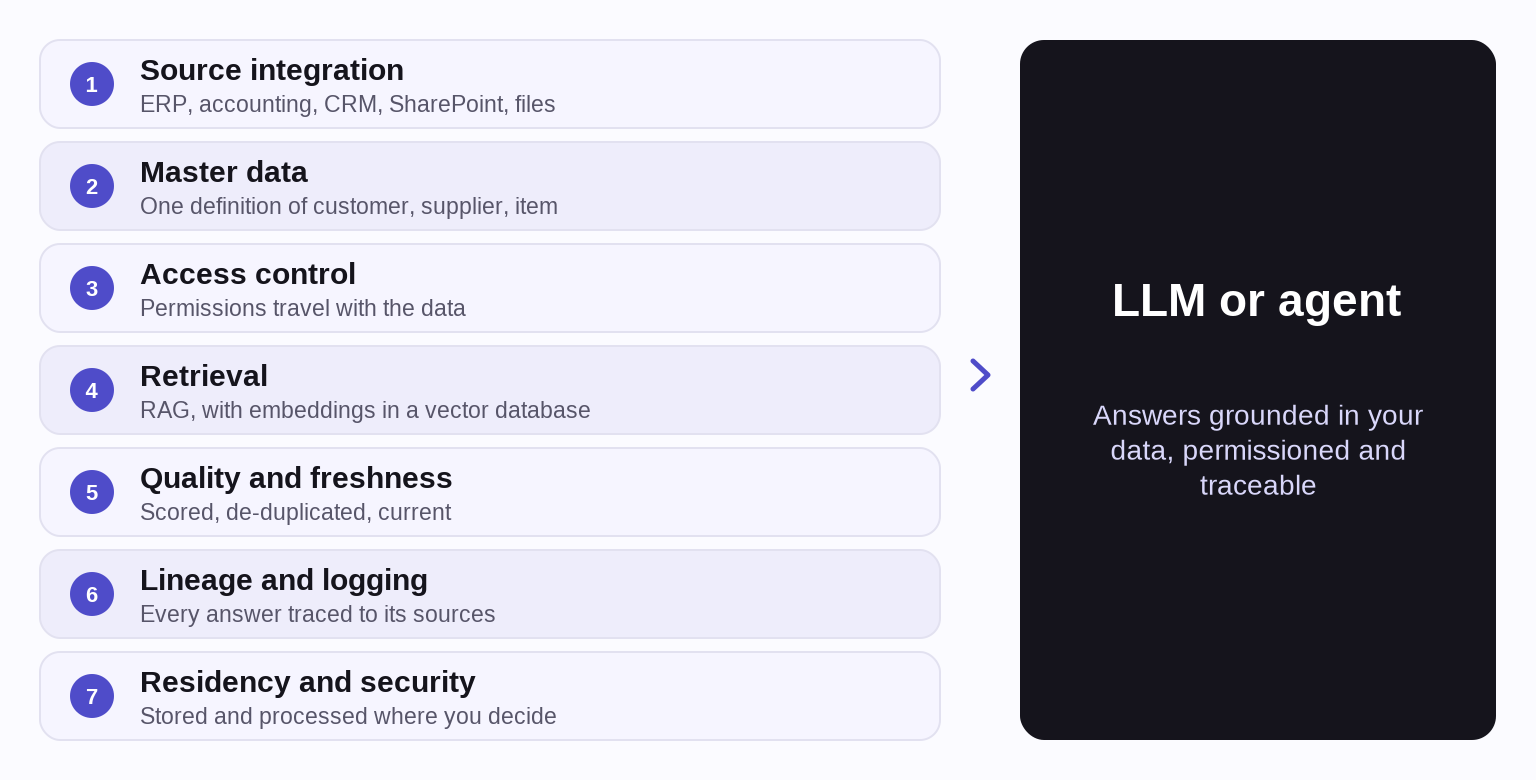
Seven building blocks
- Source integration: connections to ERP, accounting, CRM, SharePoint, files and databases, so data is read where it lives instead of being exported by hand.
- Master data: one agreed definition of customers, suppliers, items and accounts, so the model does not meet three versions of the same customer.
- Access control: permissions travel with the data. A user, or an agent acting for one, should only retrieve what that user may see.
- Retrieval: search over your documents and records, usually retrieval-augmented generation (RAG), often with embeddings stored in a vector database so related content is found even when the words differ.
- Quality and freshness: sources are scored, duplicates removed and updates flow in, so answers do not rest on last year's policy.
- Lineage and logging: every answer can be traced to the sources and the version of the model that produced it.
- Residency and security: you know where data is stored and processed, for example only inside the EU, and sensitive fields are masked or excluded.
Common mistakes
| Mistake | What happens | Better |
|---|---|---|
| Dump every document into a vector store | Outdated, duplicate and confidential content is retrieved | Curate sources, set owners and review dates |
| Ignore permissions in retrieval | A user sees content they should not | Enforce access rules at query time |
| Treat master data as an IT clean-up | The model mixes up customers and items | Make it a governed, owned asset |
| Skip logging | Nobody can explain a wrong answer | Record query, sources, model and result |
| Copy the data into a new silo | More cost, more risk, stale copies | Connect to the source; store only what you need |
Start where the value is
You do not need to fix every system before you start. Pick one process, such as invoice handling or monthly reporting, identify the five or six sources it depends on and get those right: connected, permissioned, current and logged. Then reuse the same foundation for the next use case. Each project makes the next one faster.
Do not forget the people
Data infrastructure is also a set of responsibilities. Every source needs an owner who answers for its quality, and someone who decides who may use it for AI. Without that, the best technical design drifts.
If you want to see what your own data foundation would need for a first agent, book a discovery call. We map the sources, the gaps and the quickest route to a working use case.