A board does not want to hear that AI is promising. It wants to know what it costs, what it returns and how sure we are. Answering that takes discipline before the project starts, not a clever dashboard at the end.
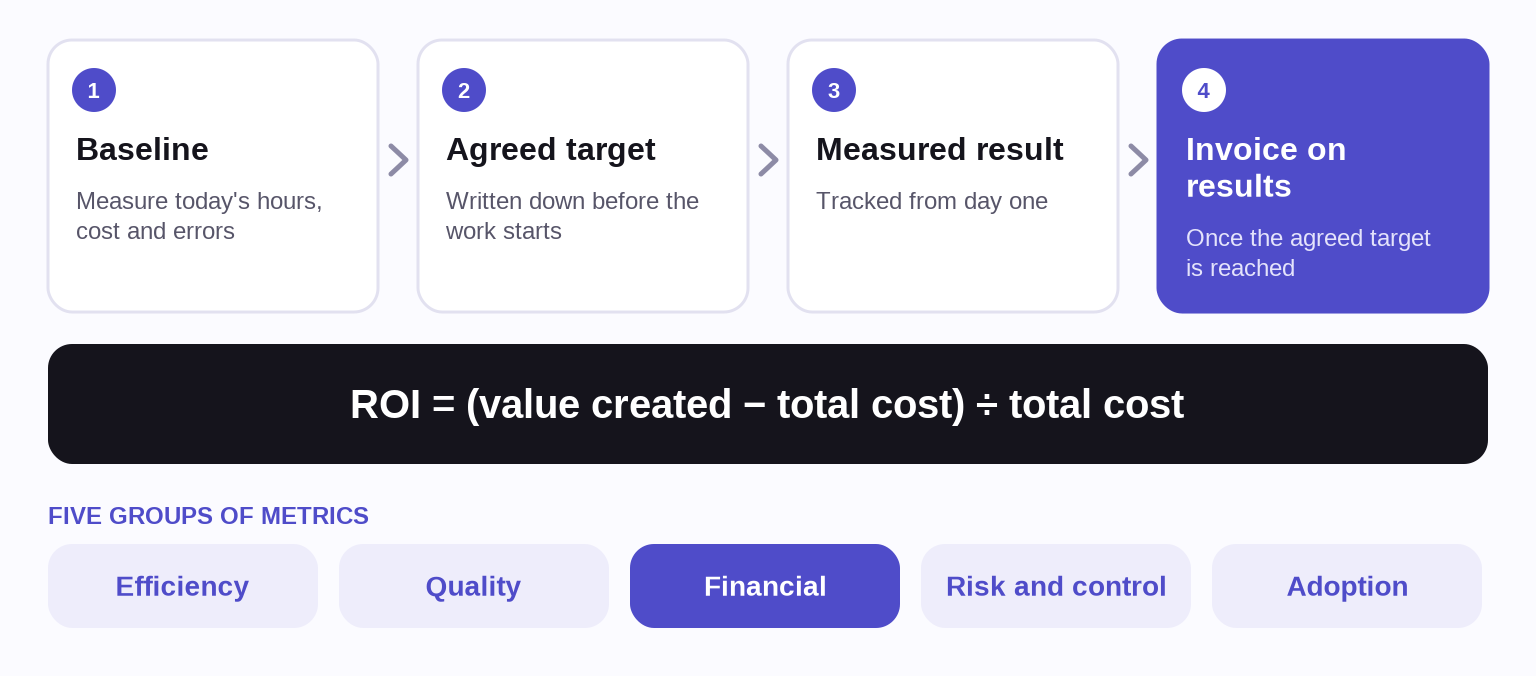
Start with a baseline and a target
You cannot show improvement without a before. Measure the process as it runs today: hours spent, cost per transaction, error rate, cycle time. Then agree a target with the business owner, such as hours saved, costs reduced or revenue gained, and a date by which it should be reached.
Five groups of metrics
| Group | Example metrics | Who cares |
|---|---|---|
| Efficiency | Hours saved, cycle time, tasks per person | Operations, finance |
| Quality | Error rate, rework, customer complaints | Operations, quality |
| Financial | Cost avoided, revenue gained, cost per transaction | CFO, board |
| Risk and control | Incidents, audit findings, approvals bypassed | Risk, compliance, board |
| Adoption | Weekly active users, share of eligible work done by agents | CIO, business owners |
A board report needs at least one number from the financial group, one from risk and one from adoption. Efficiency and quality metrics explain why those numbers moved.
A simple formula
ROI = (value created minus total cost) divided by total cost. Payback is the time it takes for cumulative value to exceed cumulative cost. Be explicit about both sides.
- Value: convert hours saved to money only when the time is actually redeployed or a cost really disappears. Otherwise report it as capacity, not cash.
- Cost: include model usage, integration, the platform, training, governance and the people who review the output.
Common mistakes
- Counting hours saved as money that never reaches the budget.
- Reporting activity (prompts sent, agents deployed) instead of results.
- Leaving out the cost of governance and review, which flatters the ROI.
- Measuring at the pilot and extrapolating to the whole company.
- Having no baseline, so every improvement is an opinion.
Make ROI a contract, not a hope
We build this into how we work. Before a project starts we map the process, measure the baseline and agree a measurable ROI target in writing. We track it from day one, and we invoice once the agreed target is reached. It forces clear thinking from both sides, and it gives the board a number it can hold us to.
If you need an ROI case for your board, book a discovery call. We will map one process, set the baseline and propose a target you can take to the next meeting.