More people now ask AI tools a question and read the answer instead of ten blue links. Tools such as ChatGPT search and Perplexity search the web, write a short answer and cite a handful of sources. Answer engine optimization (AEO), also called generative engine optimization (GEO), is about making your content easy for those systems to find, understand and cite. Nobody can promise a result, and the techniques are still changing, but the basics are clear and mostly good practice anyway.
1. Answer first
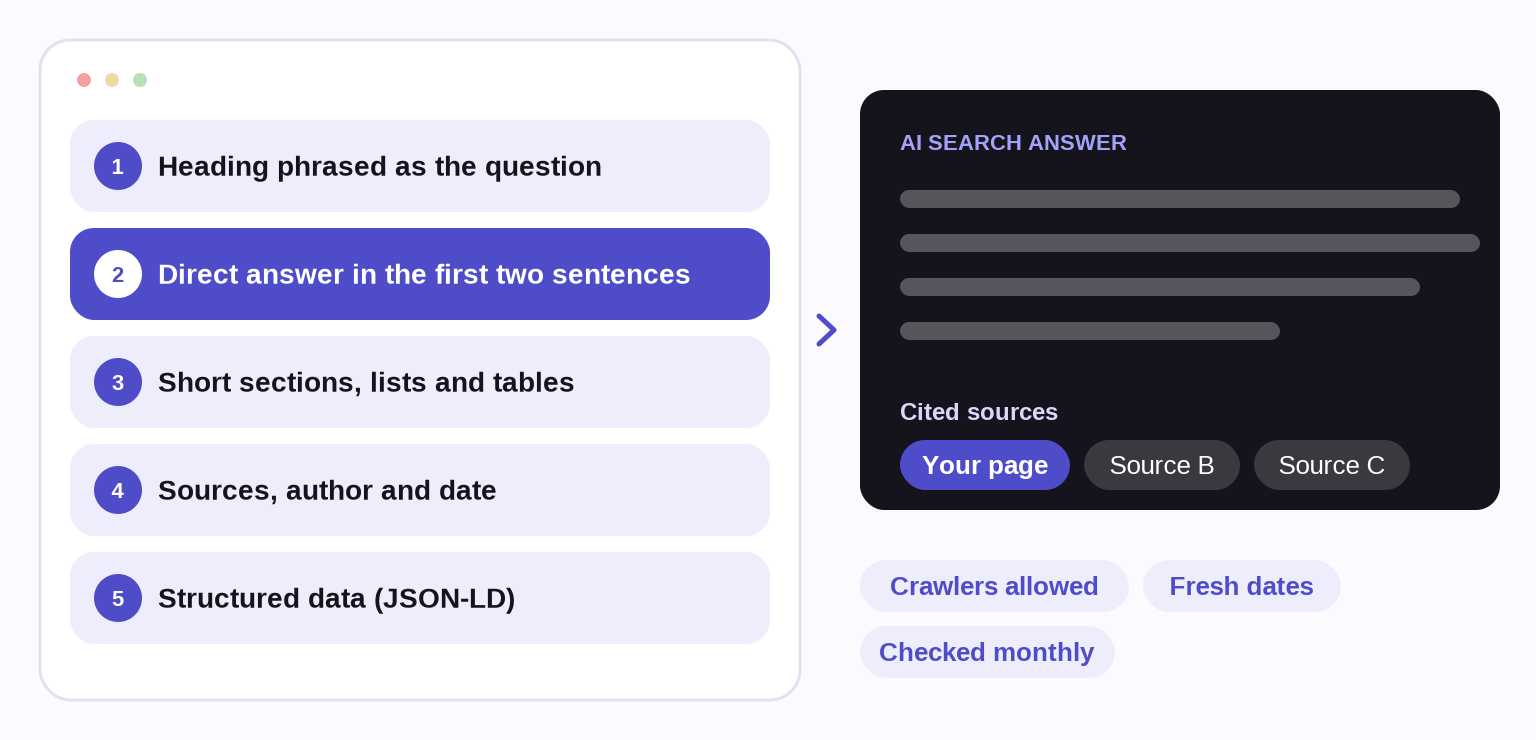
Put the direct answer in the first one or two sentences under a heading that matches the question people ask. Then add the detail. Content that opens with a clear, self-contained answer is easier to quote correctly than content that builds up to it.
2. Structure the page like questions and answers
- Use descriptive headings, ideally phrased as the question.
- Keep paragraphs short and each one to a single idea.
- Use lists and tables for steps, comparisons and definitions.
- Define terms in plain language, once, near the top.
3. Be unmistakably who you are
AI systems build a picture of organisations and people from many sources. State your name, what you do, where you are and who wrote the page, consistently. Add structured data (schema.org JSON-LD) for the organisation, articles and authors, so machines do not have to guess.
4. Let the right crawlers in
If a crawler is blocked in robots.txt, its tool cannot read the page. Decide deliberately which AI crawlers you allow, and make sure pages are fast, server-rendered and readable without scripts. Some sites also publish an llms.txt file, a plain-text summary for language models. It is a proposed convention and its effect is unproven, so treat it as a cheap extra, not a plan.
5. Give them something worth citing
Original data, clear definitions, worked examples and named sources are what get quoted. Cite your own sources, show the date, and update pages when facts change. Thin content that repeats what everyone else says has no reason to be cited.
6. Measure by asking
Traffic reports will not show the whole picture. Each month, ask the main AI tools the questions your customers ask, and note whether you are cited, how you are described and what is wrong. Fix the pages behind the errors.
A short checklist
| Check | Done when |
|---|---|
| Answer-first openings | Each key page answers its question in the first two sentences |
| Structured data | Organisation, article and author data validate without errors |
| Crawler access | robots.txt reflects a deliberate decision about AI crawlers |
| Freshness | Every page shows a date and is reviewed on a schedule |
| Citation check | A monthly set of questions is tested and recorded |
We apply the same practices on alphaise.com, with structured data and an llms.txt file. If you want a review of how AI search describes your company, book a discovery call.